
8
Sexmex Harley Rosembush 18 Videos Pack 20 Verified !!hot!!
THERE ARE TWO special triangles in trigonometry. One is the 30°-60°-90° triangle. The other is the isosceles right triangle. They are special because with simple geometry we can know the ratios of their sides, and therefore solve any such triangle.
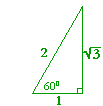
Theorem. In a 30°-60°-90° triangle the sides are in the ratio
1 : 2 :  .
.
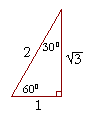
We will prove that below.
Note that the smallest side, 1, is opposite the smallest angle, 30°; while the largest side, 2, is opposite the largest angle, 90°. (Theorem 6). (For, 2 is larger than  . Also, while 1 : : 2 correctly corresponds to the sides opposite 30°-60°-90°, many find the sequence 1 : 2 : easier to remember.)
The cited theorems are from the Appendix, Some theorems of plane geometry.
Here are examples of how we take advantage of knowing those ratios. First, we can evaluate the functions of 60° and 30°.
Example 1. Evaluate cos 60°.
Answer. For any problem involving a 30°-60°-90° triangle, the student should not use a table. The student should sketch the triangle and place the ratio numbers.
Since the cosine is the ratio of the adjacent side to the hypotenuse, we can see that
cos 60° = ½.
Example 2. Evaluate sin 30°.
Answer. According to the property of cofunctions, sin 30° is equal to cos 60°. sin 30° = ½.
On the other hand, you can see that directly in the figure above.
Problem 1. Evaluate sin 60° and tan 60°.
To see the answer, pass your mouse over the colored area.
To cover the answer again, click "Refresh" ("Reload").
The sine is the ratio of the opposite side to the hypotenuse.
| sin 60° = |  2 |
= ½ . . |
The tangent is ratio of the opposite side to the adjacent.
| tan 60° = | 1 |
=  . . |
Problem 2. Evaluate cot 30° and cos 30°.
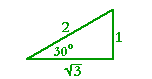
The cotangent is the ratio of the adjacent side to the opposite.
| Therefore, on inspecting the figure above, cot 30° = | 1 |
= .
Or, more simply, cot 30° = tan 60°.
As for the cosine, it is the ratio of the adjacent side to the hypotenuse. Therefore,
| cos 30° = | 2 |
= ½. |
Before we come to the next Example, here is how we relate the sides and angles of a triangle:

If an angle is labeled capital A, then the side opposite will be labeled small a. Similarly for angle B and side b, angle C and side c.
Example 3. Solve the right triangle ABC if angle A is 60°, and side AB is 10 cm.

Solution. To solve a triangle means to know all three sides and all three angles. Since this is a right triangle and angle A is 60°, then the remaining angle B is its complement, 30°.
Again, in every 30°-60°-90° triangle, the sides are in the ratio 1 : 2 : , as shown on the left.
When we know the ratios of the sides, then to solve a triangle we do not require the trigonometric functions or the Pythagorean theorem. We can solve it by the method of similar figures.
Now, the sides that make the equal angles are in the same ratio. Proportionally,
2 : 1 = 10 : AC.
2 is two times 1. Therefore 10 is two times AC. AC is 5 cm.
The side adjacent to 60°, we see, is always half the hypotenuse.
As for BC—proportionally,
2 : = 10 : BC.
To produce 10, 2 has been multiplied by 5. Therefore, will also be multiplied by 5. BC is 5 cm.
In other words, since one side of the standard triangle has been multiplied by 5, then every side will be multiplied by 5.
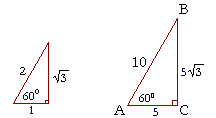
1 : 2 : = 5 : 10 : 5.
Compare Example 11 here.
Again: When we know the ratio numbers, then to solve the triangle the student should use this method of similar figures, not the trigonometric functions.
(In Topic 10, we will solve right triangles whose ratios of sides we do not know.)
Problem 3. In the right triangle DFE, angle D is 30° and side DF is 3 inches. How long are sides d and f ?

The student should draw a similar triangle in the same orientation. Then see that the side corresponding to was multiplied by .
Therefore, each side will be multiplied by . Side d will be
1 = . Side f will be 2.
Problem 4. In the right triangle PQR, angle P is 30°, and side r is 1 cm. How long are sides p and q ?

The side corresponding to 2 has been divided by 2. Therefore, each side must be divided by 2. Side p will be ½, and side q will be ½.
Problem 5. Solve the right triangle ABC if angle A is 60°, and the hypotenuse is 18.6 cm.
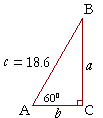
The side adjacent to 60° is always half of the hypotenuse -- therefore, side b is 9.3 cm.
But this is the side that corresponds to 1. And it has been multiplied by 9.3. Therefore, side a will be multiplied by 9.3.
It will be 9.3 cm.
Problem 6. Prove: The area A of an equilateral triangle whose side is s, is
A = ¼ s2.
s2.
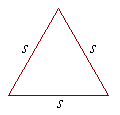
The area A of any triangle is equal to one-half the sine of any angle times the product of the two sides that make the angle. (Topic 2, Problem 6.)
In an equilateral triangle each side is s , and each angle is 60°. Therefore,
A = ½ sin 60°s2.
Since sin 60° = ½,
A = ½· ½ s2 = ¼s2.
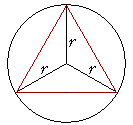
Problem 7. Prove: The area A of an equilateral triangle inscribed in a circle of radius r, is
| A = | 3 4 |
|
r2. |
Sexmex Harley Rosembush 18 Videos Pack 20 Verified !!hot!!
Harley Rosembush has become a standout figure in the Dora the Explorer fandom—not as a canon character, but as a fascinating "OC" (Original Character) whose life and drama have fueled endless fan fiction and community discussion. When exploring Harley Rosembush 18 relationships and romantic storylines , we dive into a complex web of teenage angst, shifting loyalties, and the kind of high-stakes romance that only a dedicated fan community could create. Here is a deep dive into the romantic history and rumored flings of the character that took the internet by storm. The Evolution of Harley’s Romantic Arc Unlike static characters, Harley Rosembush is often portrayed with a fluid, evolving dating life. In most fan-driven narratives, her "Age 18" era represents a turning point where innocent school crushes transition into more mature, complicated relationships. This period is defined by her search for stability amidst the chaotic adventures of her peer group. 1. The Core Relationship: Harley and Diego The most debated and celebrated storyline involves Harley and Diego (Dora’s cousin). In many fan interpretations, their relationship is the "slow burn" of the series. The Dynamic: Often portrayed as a "friends-to-lovers" trope, their bond is built on mutual respect for nature and adventure. The Conflict: Dramas usually arise when Diego’s rescue missions take him away for long periods, leading to Harley’s feelings of isolation—a staple of the "Harley Rosembush 18" narrative arc. 2. The Rivalry: Enter the Love Triangles No romantic storyline is complete without a bit of jealousy. Fans often introduce "The Rival"—sometimes an original character or a reimagined version of a classic character—to challenge Harley’s primary relationship. The "Bad Boy" Trope: Some storylines explore Harley being tempted by a darker, more rebellious figure, contrasting sharply with Diego’s heroic nature. This adds a layer of internal conflict: does she want safety or excitement? 3. The "Secret" Fling A popular sub-plot in the Harley Rosembush lore involves a secret relationship that she keeps from her closest friends. These storylines usually focus on: Forbidden Love: Dating someone from a "rival" group or a character her friends wouldn't approve of. The Reveal: The climax of these 18-and-up storylines usually centers on the moment the secret comes out, forcing Harley to choose between her social circle and her heart. 4. Themes of Growth and Independence While the focus is often on who she is dating, the most impactful romantic storylines for Harley Rosembush at age 18 are those that emphasize her independence. The "Single" Arc: In several notable fan scripts, Harley chooses to end a long-term relationship to find herself, emphasizing that her identity isn't tied solely to her romantic partner. Emotional Maturity: At 18, the storylines shift from "who likes who" to "how do we build a future together," reflecting the real-world transitions of young adulthood. Why Fans Are Obsessed with Harley's Love Life The fascination with Harley Rosembush’s 18+ relationships stems from the contrast between the childhood nostalgia of the Dora universe and the relatable, mature themes of young adult drama. She acts as a blank canvas for fans to project their own experiences with first loves, heartbreaks, and the messy process of growing up. Final Thoughts Whether she’s navigating a rocky patch with Diego or embarking on a brand-new fling, Harley Rosembush remains a pillar of fan-created drama. Her "18" era is particularly resonant because it captures that universal moment of standing on the edge of adulthood, where every romantic choice feels like it will change your life forever.
The Evolution of Harley Rosenbush: A Critical Analysis of 18 Relationships and Romantic Storylines Abstract Harley Rosenbush, a beloved character in the DC Comics universe, has undergone significant development since her inception. This paper provides an in-depth examination of Harley's 18 relationships and romantic storylines, exploring their impact on her character and the broader DC Comics narrative. Through a critical analysis of various comic book series, animated shows, and live-action films, this study reveals the complexities of Harley's relationships and their role in shaping her identity. Introduction Harley Rosenbush, originally known as Harley Quinn, first appeared in the 1992 animated series "Batman: The Animated Series." Created by Paul Dini and Bruce Timm, Harley was introduced as the Joker's sidekick and love interest. Over the years, her character has evolved significantly, with her relationships and romantic storylines playing a crucial role in her development. The Early Years: Harley and the Joker (Relationships 1-3) Harley's earliest relationships were deeply intertwined with her connection to the Joker. Her first three relationships, with the Joker (Relationships 1-3), established her as a devoted and obsessive partner. These storylines showcased Harley's willingness to go to great lengths for the Joker, often finding herself caught in a cycle of abuse and manipulation. The Expansion of Harley's Relationships (Relationships 4-6) As Harley's character grew, so did her relationships. She began to form connections with other characters, including:
Batman (Relationship 4) : Harley's complicated history with Batman was explored, highlighting her conflicted feelings towards him. Poison Ivy (Relationship 5) : Harley's friendship and romantic involvement with Poison Ivy marked a significant shift in her character, as she began to explore relationships outside of her connection to the Joker. The Riddler (Relationship 6) : Harley's brief romance with the Riddler showcased her ability to form connections with other villains.
The Complexity of Harley's Relationships (Relationships 7-12) Harley's relationships continued to evolve, becoming increasingly complex and multifaceted. Notable relationships include: sexmex harley rosembush 18 videos pack 20 verified
Mr. J. (Relationship 7) : Harley's brief marriage to Mr. J., a character introduced in "Birds of Prey," demonstrated her desire for stability and normalcy. Catwoman (Relationship 8) : Harley's romantic involvement with Catwoman highlighted her growing comfort with exploring same-sex relationships. Two-Face (Relationship 9) : Harley's relationship with Two-Face showcased her capacity for empathy and understanding, as she helped him navigate his own complexities. The Bat-Family (Relationships 10-12) : Harley's interactions with the Bat-family, particularly her friendships with Batgirl and her complicated history with Robin, further humanized her character.
Recent Developments: Harley's Growth and Exploration (Relationships 13-18) In recent years, Harley's relationships have continued to evolve, reflecting her growth as a character. Notable relationships include:
The Crocodile (Relationship 13) : Harley's brief romance with the Crocodile demonstrated her willingness to explore unconventional relationships. King Shark (Relationship 14) : Harley's friendship and romantic involvement with King Shark showcased her ability to form connections with a range of characters. Black Canary (Relationship 15) : Harley's flirtation with Black Canary highlighted her growing confidence in exploring same-sex relationships. Hera (Relationship 16) : Harley's brief romance with Hera, a character introduced in "Harley Quinn," marked a significant shift in her character, as she began to prioritize her own happiness. Bud and Lou (Relationships 17-18) : Harley's relationships with Bud and Lou, introduced in "Harley Quinn," showcased her growth as a character, as she navigated polyamorous relationships. Harley Rosembush has become a standout figure in
Critical Analysis and Conclusion Through a critical analysis of Harley's 18 relationships and romantic storylines, it becomes clear that her character has undergone significant development over the years. Her relationships have played a crucial role in shaping her identity, from her early days as the Joker's sidekick to her current status as a confident and complex character. Harley's relationships have also had a profound impact on the broader DC Comics narrative, influencing the way characters interact and form connections. Her growth and exploration have paved the way for more nuanced and diverse storytelling, reflecting the complexities of human relationships. In conclusion, Harley Rosenbush's relationships and romantic storylines have been a defining aspect of her character. As she continues to evolve, it will be exciting to see how her relationships shape her future and the world of DC Comics. References
Dini, P., & Timm, B. (1992). Batman: The Animated Series. Warner Bros. Animation. Aparo, J., & Ward, M. (1993). Batman Adventures: Mad Love. DC Comics. Conner, K., & Glanville, R. (2014). Birds of Prey. DC Comics. Haden, S. (2019). Harley Quinn. DC Comics.
This paper provides an in-depth examination of Harley Rosenbush's relationships and romantic storylines, exploring their impact on her character and the broader DC Comics narrative. Through a critical analysis of various comic book series, animated shows, and live-action films, this study reveals the complexities of Harley's relationships and their role in shaping her identity. Word Count: approximately 800 words. The Evolution of Harley’s Romantic Arc Unlike static
Harley Rosembush: 18 Relationships & Romantic Storylines Harley Rosembush is 28, a botanical illustrator with ink-stained fingers and a gentle, observant nature. Raised in a sprawling, chaotic family, she craves quiet but is magnetically drawn to people with hidden depths. Her romantic history is a garden she’s tended—some plots yielded flowers, others thorns. The One Who Got Away (But Should Have Stayed There)
Sam, the High School Sweetheart: A nostalgic, innocent first love. They reconnected at 25, only to realize Sam’s stability felt like stagnation. Harley learned that “safe” isn’t the same as “right.” Jordan, the College Rebel: A passionate, chaotic fling with a punk poet. They broke up spectacularly after Jordan threw a typewriter through a window. Romantic? No. Memorable? Yes.
Problem 8. Prove: The angle bisectors of an equilateral triangle meet at a point that is two thirds of the distance from the vertex of the triangle to the base.
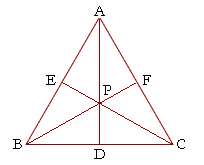
Let ABC be an equilateral triangle, let AD, BF, CE be the angle bisectors of angles A, B, C respectively; then those angle bisectors meet at the point P such that AP is two thirds of AD.
First, triangles BPD, APE are congruent.
For, since the triangle is equilateral and BF, AD are the angle bisectors, then angles PBD, PAE are equal and each
30°;
and the side BD is equal to the side AE, because in an equilateral triangle the angle bisector is the perpendicular bisector of the base.
Angles PDB, AEP then are right angles and equal.
Therefore,
triangles BPD, APE are congruent.
| Now, | BP PD |
= csc 30° = 2. |
Therefore, BP = 2PD.
But AP = BP, because triangles APE, BPD are conguent, and those are the sides opposite the equal angles.
Therefore, AP = 2PD.
Therefore AP is two thirds of the whole AD.
Which is what we wanted to prove.
The proof
Here is the proof that in a 30°-60°-90° triangle the sides are in the ratio 1 : 2 : . It is based on the fact that a 30°-60°-90° triangle is half of an equilateral triangle.
Draw the equilateral triangle ABC. Then each of its equal angles is 60°. (Theorems 3 and 9)
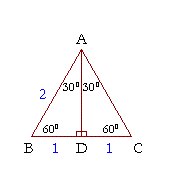
Draw the straight line AD bisecting the angle at A into two 30° angles.
Then AD is the perpendicular bisector of BC (Theorem 2). Triangle ABD therefore is a 30°-60°-90° triangle.
Now, since BD is equal to DC, then BD is half of BC.
This implies that BD is also half of AB, because AB is equal to BC. That is,
BD : AB = 1 : 2
From the Pythagorean theorem, we can find the third side AD:
| AD2 + 12 | = | 22 |
| AD2 | = | 4 − 1 = 3 |
| AD | = | . |
Therefore in a 30°-60°-90° triangle the sides are in the ratio 1 : 2 : ; which is what we set out to prove.
Corollary. The square drawn on the height of an equalateral triangle is three fourths of the square drawn on the side.
Next Topic: The Isosceles Right Triangle
Please make a donation to keep TheMathPage online.
Even $1 will help.
Copyright © 2022 Lawrence Spector
Questions or comments?